

The Regenerative Prosperity Model

Surendra Reddy // created on April 8, 2020 // last updated on March 25, 2025
Why a New Model of Prosperity?
For the past century, humanity’s understanding of prosperity has rested on a simple framework: economic growth, material abundance, and efficiency. This model, born of the Industrial Revolution, was instrumental in creating the wealth we now consider standard. It reduced poverty and built the infrastructure that powers the modern economy, and on its own terms it succeeded.
But that paradigm, centered on extraction and growth, is reaching the limits of what it can deliver. Our assumptions about what it means to be prosperous no longer hold in an era marked by climate change, deteriorating ecosystems, rising inequality, and social fragmentation. These are symptoms of a system that has valued extraction over restoration, growth over regeneration, and short-term gain over long-term sustainability.
Despite extraordinary technological achievement and unprecedented global connectivity, we face a set of compounding crises:
Food security. Our food supply is abundant but increasingly nutrient-poor, grown on industrial farms that harm both human health and planetary ecosystems. Analyses of USDA composition data across the second half of the twentieth century document measurable declines in protein, calcium, phosphorus, iron, and other nutrients in common crops (Davis, Epp, & Riordan, 2004).
Soil degradation. Soils are deteriorating rapidly, losing the capacity to support crop growth or preserve biodiversity, with direct consequences for food security and long-term sustainability. The first global assessment of soil health found the majority of the world’s soils in only fair, poor, or very poor condition (FAO & ITPS, 2015).
Community fragmentation. Communities are increasingly fragmented, with rising burnout and inequality even in a hyper-connected world.
Climate destabilization. The fossil fuel foundation on which traditional prosperity was built is now destabilizing the climate and ecosystems it once seemed to serve.
None of this is a failure within the current economic system. It is the predictable outcome of an economic model designed to maximize extraction and efficiency. That model worked remarkably well for a time. As we enter a new era, it is becoming clear that it no longer serves us, and that our definition of prosperity has to change with it. Earth-system researchers describe several biophysical boundaries already transgressed, among them climate change, biodiversity loss, and the nitrogen cycle (Rockström et al., 2009).
We are at a crossroads, holding onto systems and definitions that no longer make sense. Incremental fixes will not be enough. What is needed is a more fundamental rethinking of what prosperity can be: a model that heals the damage already done while sustaining the generations still to come.
Introducing RPM: The Regenerative Prosperity Model
Having seen firsthand how abundance can mask depletion, how growth on a spreadsheet can coexist with decay in the soil, I built the Regenerative Prosperity Model (RPM) as an answer to a single question: what does true prosperity actually mean?
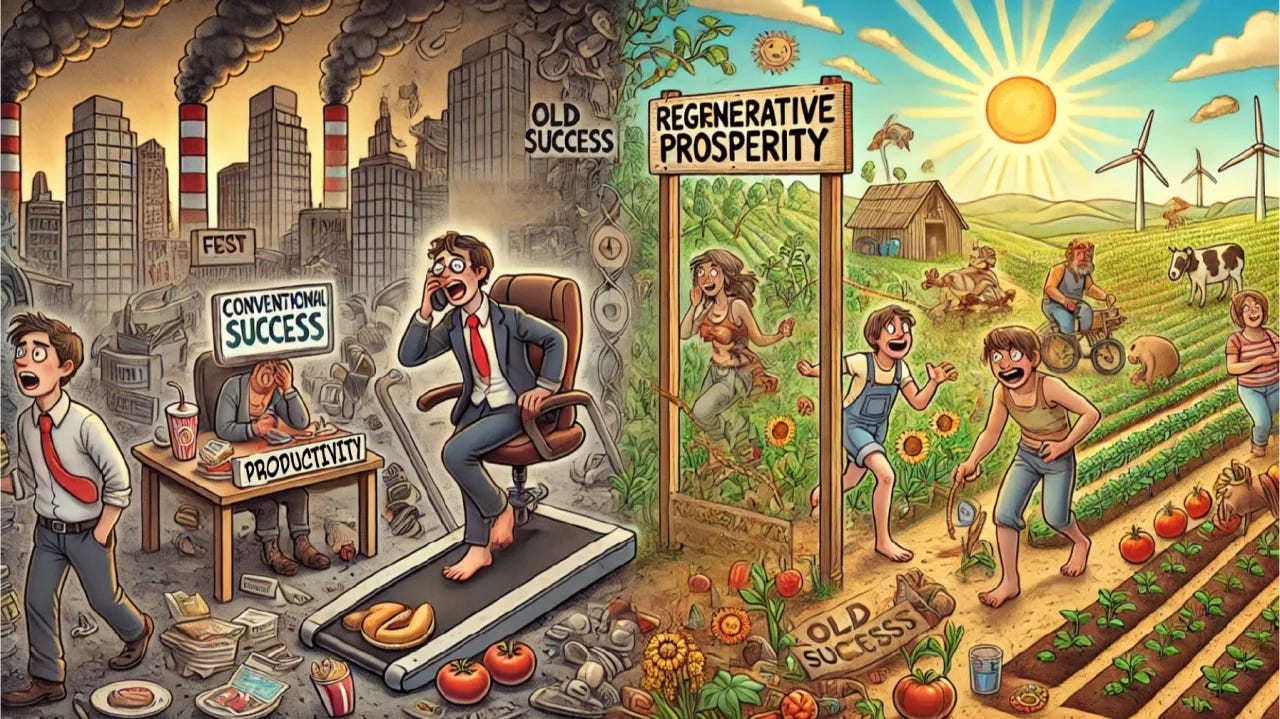
RPM redefines prosperity around regenerative principles, moving away from extractive, short-term thinking toward a more holistic, long-term view of vitality and sustainability. In this framework, prosperity is no longer just about accumulation. It is about restoration, collaboration, and synergy across every dimension of life: human health, ecological vitality, social equity, and sustainable wealth generation. This places RPM in conversation with a wider body of regenerative and post-growth economic thought (Fullerton, 2015; Raworth, 2017).
At its core, RPM consists of five interwoven regenerative components:
Self: our individual and collective health, the foundation everything else is built on.
Nature: ecological restoration and resilience, grounded in the inextricable link between human health and the health of our ecosystems.
Community: social equity, collaboration, and collective thriving, ensuring no one is left behind as we regenerate.
Design: thoughtful, adaptive innovation rooted in ecological intelligence, providing the tools to meet our regenerative goals.
Capital: regenerative finance that values life, ecological restoration, and equity, so that financial returns stay aligned with long-term regeneration.
Together, these components form a coherent, holistic framework for measuring, investing in, and realizing genuine prosperity, one that benefits not just a few but all of us: people, planet, and the generations still to come. Before working through each component in detail, it helps to understand the underlying shift in thinking that RPM represents.
From Extraction to Regeneration
At the heart of the traditional model of prosperity is extraction: of resources, of labor, of time. For decades the primary measures of success were gross domestic product (GDP), productivity, and efficiency, with little regard for the long-term health of the ecosystems and communities underwriting that growth. Success was measured by how much could be taken from the land, the people, and the environment in pursuit of short-term profit.
The problem is that this model is inherently unsustainable. Our resources are finite, and the ecosystems that support us cannot be exploited indefinitely without causing irreversible damage. RPM moves away from extraction and toward a regenerative model built around three priorities.
Value creation through restoration. Instead of exploiting resources, RPM focuses on regenerating and restoring ecosystems, resources, and human well-being. This is about building long-term value rather than extracting short-term wealth.
Long-term ecological and social health. Prosperity under RPM is measured by the health of soils, biodiversity, communities, and ecosystems, not by the economy alone. Working within the limits of our ecosystems is what makes the wealth we generate sustainable and ethical.
Collaboration, stewardship, and equity. True prosperity requires collaboration between people, nature, and capital: shared stewardship of the earth’s resources and a collective approach to the challenges we face. Prosperity cannot be achieved by a few at the expense of the many. It has to be equitable.
This is more than a shift in business strategy or economic policy. It is a paradigm shift in how we define success, one that changes how we think about food, energy, infrastructure, and investment. Instead of maximizing growth at all costs, RPM maximizes health, resilience, and restoration over time.
RPM’s Core Components: A Regenerative Framework
Self: Empowering the Individual and Collective Health
In RPM, Self refers to individual health and collective health together. A society’s prosperity depends on the well-being of its people, both individually and collectively, which includes physical health alongside mental health, emotional well-being, and empowerment.
Empowerment in RPM
Entrepreneurs. In the RPM model, entrepreneurs are empowered to build businesses around long-term regenerative goals rather than profit maximization alone, designing for the regeneration of ecosystems, communities, and people as part of a larger, purpose-driven mission rather than simply a means of earning money.
Employees. Employees are co-creators of the value a company generates, not just labor. Companies that align with RPM principles invest in their employees’ personal growth, offering meaningful work, professional development, and a purpose-driven environment.
Consumers. RPM calls for a new form of consumerism, one where individuals are empowered to make decisions aligned with their values, choosing goods and services that regenerate the planet and society rather than products extracted from the earth and from people.
Why Health Is Central
RPM rests on the belief that true prosperity starts with individual health. Healthy people build healthy communities, and healthy communities build a healthy planet. By centering health, the model shifts the focus from productivity at all costs to sustainable growth that nourishes individuals and the planet together.
Nature: Ecological Restoration and Resilience
The Nature component of RPM rests on the recognition that human well-being is inseparable from the health of the ecosystems that support us. The traditional economic model treated nature as a resource to be exploited for economic gain. RPM inverts that, holding that nature must be restored and protected for the prosperity of future generations.
Key Elements of Nature in RPM
Soil health. Soil regeneration sits at the heart of RPM. Healthy soils are the foundation for food security, biodiversity, and climate resilience.
Biodiversity. Protecting biodiversity is essential to ecosystem resilience. RPM calls for investment in natural systems, including forests, wetlands, and marine ecosystems, that play critical roles in carbon sequestration, water filtration, and climate stabilization. The scale of the challenge is stark: a global scientific assessment estimated that around one million species face extinction, many within decades (IPBES, 2019).
Circular systems. RPM promotes a transition to circular economies, where waste is minimized and resources are continuously reused and recycled. This keeps activity within the limits of the planet’s resources while creating sustainable long-term value.
Community: Social Equity and Collective Thriving
RPM treats communities as the cornerstone of regenerative systems. Prosperity is not just about wealth; it is about well-being for all people, especially those who have historically been marginalized. Social equity, collaboration, and shared prosperity are the foundational pillars of the Community component.
Key Aspects of Community in RPM
Local economies. RPM encourages resilient local economies that are less dependent on global supply chains and more connected to local resources and people.
Governance. RPM supports inclusive governance models built on participation, cooperation, and shared decision-making. Rather than a top-down structure, RPM envisions distributed governance in which communities have a real say in how their resources are used and managed.
Equity. Social equity is a core principle of RPM. It means addressing historical inequalities directly and ensuring that everyone, regardless of background, has access to the benefits of prosperity.
Design: Innovation Rooted in Ecological Intelligence
The Design component of RPM is about creating solutions that are not just innovative but adaptive and ecologically intelligent. Design in RPM is not disruptive innovation that breaks systems down; it is adaptive solutions that align with natural systems and societal needs.
Key Principles of Design in RPM
Sustainable product design. Solutions that prioritize ecological regeneration and human health while still meeting market needs.
Adaptive innovation. Systems built to evolve alongside changing environmental conditions, technological advances, and community needs.
Holistic systems thinking. Solutions that integrate social, economic, and environmental factors into a single, cohesive whole.
Capital: Regenerative Finance
Capital in RPM is not just about maximizing financial returns. It is about directing investment toward impact, in ways that are aligned with regenerative goals. RPM’s capital system promotes long-term sustainability and ecosystem regeneration while keeping businesses financially viable.
Key Principles of Capital in RPM
Patient capital. Long-term investments that prioritize regenerative outcomes over short-term profit.
Impact investing. Capital directed toward ventures aligned with sustainable and socially equitable goals, ensuring that money flows into work that creates positive environmental and social impact. The field defines such investments by their intention to generate measurable social or environmental impact alongside a financial return (Global Impact Investing Network, 2019).
Blended finance. Models that mix public and private funds, allowing regenerative businesses to scale without sacrificing social or ecological returns.
What Makes RPM Unique?
RPM differentiates itself from other sustainability or regenerative models through its explicit integration of five interconnected components. Many models treat ecological regeneration, social equity, or economic prosperity in isolation. RPM treats them as interdependent and integral to true prosperity, with each piece feeding into the others to create a synergistic system of growth and regeneration.
Frameworks such as ESG (Environmental, Social, and Governance) represent a genuine step forward, but they tend to concentrate on individual sectors, attempting to solve energy, food, or technology problems in isolation, and they focus primarily on risk mitigation. RPM takes a systems approach instead, ensuring that each component works together to create a resilient, holistic, and adaptive whole.
The fundamental difference is that regeneration in RPM is not only ecological. It is human and social as well. True prosperity, on this view, has to encompass every dimension of life: human health, ecological vitality, social integrity, technological ethics, and regenerative finance. Sustainability, in this framing, is not merely about reducing harm. It is about creating new opportunities for regeneration grounded in restoration rather than extraction and exploitation.
What sets RPM apart is that it is not just forward-thinking but practical: built to generate long-term resilience rather than short-term fixes. By integrating all five components, Self, Nature, Community, Design, and Capital, RPM creates a system in which each component reinforces the others, so that the flywheel of regeneration builds compounding momentum over time.
The RPM Flywheel: Accelerating Regeneration and Capital Outcomes
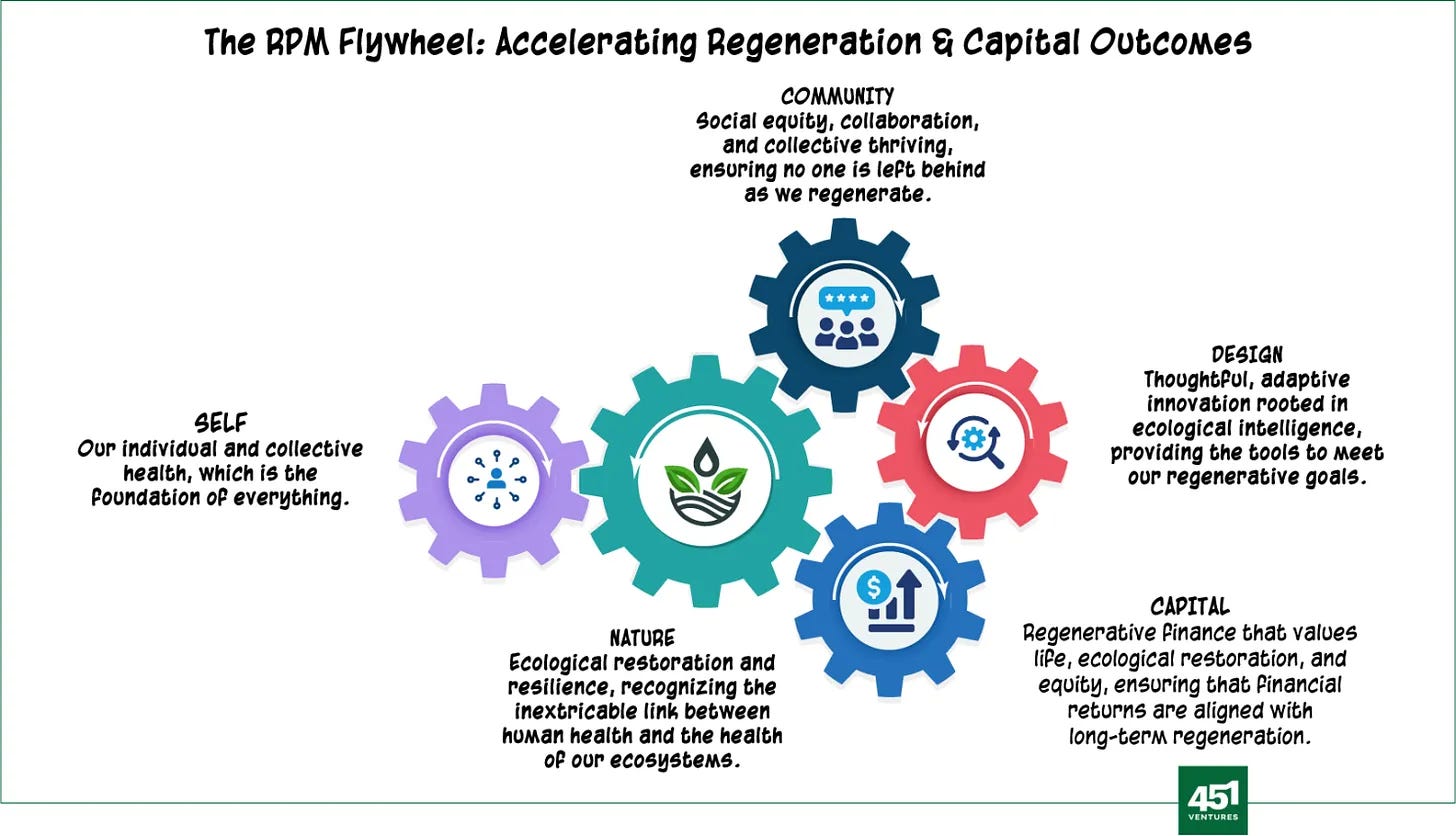
What truly sets RPM apart is its flywheel structure, which harnesses the interconnection of its five components to create synergy and momentum. Each component drives the next while also reinforcing and accelerating the regenerative outcomes that came before it. The flywheel’s momentum builds over time, with every component working together to produce compounding outcomes: both regeneration and positive returns for stakeholders.
How the flywheel spins:
Self → Nature. Empowered individuals act as catalysts for ecological regeneration. Their choices, adopting sustainable farming, reducing consumption, directly restore ecosystems and initiate a regenerative process.
Nature → Community. Regenerated ecosystems create the foundation for community action. Healthy ecosystems support local livelihoods, provide resources, and let communities scale regenerative practices collectively.
Community → Design. As communities take up regenerative practices, they generate demand for innovation. Design supplies scalable solutions, sustainable agriculture technologies and eco-businesses among them, that address ecological challenges and push the system forward.
Design → Capital. Innovative solutions attract investment, enabling regenerative solutions to scale. Capital flows into these solutions, generating financial returns for investors while furthering the regenerative mission.
Nature → Capital. As ecosystems regenerate, they create value that benefits human health and community well-being directly. Improved soil health, greater biodiversity, and better food quality reduce healthcare costs and improve quality of life, building a more resilient and productive society and opening new opportunities for capital investment. Returns are driven by the reduction of chronic disease, better nutrition through regenerative food systems, and long-term savings in healthcare and environmental restoration, so that financial growth stays aligned with the health of individuals, communities, and ecosystems, advancing sustainable prosperity and environmental restoration together.
Why Now?
If not now, when? If not a regenerative model, then what will truly carry us forward?
RPM is not a luxury. It is a necessity. We are living through converging global crises: chronic health epidemics, biodiversity loss, climate disruption, and rising inequality. These challenges are interconnected, and traditional, piecemeal solutions cannot keep pace with problems that are systemic by nature.
RPM meets this moment with deep, systemic transformation rather than temporary fixes. It is designed to address the root causes of these crises by restoring health, both human and ecological, and by shifting toward a model where growth means regeneration rather than depletion. We have to move beyond an economic model that treats growth and ecological health as a trade-off. The RPM Flywheel accelerates that shift, so that every step toward regeneration builds momentum for long-term, systemic change.
Conclusion: The Need for RPM in Today’s World
In a rapidly changing world, the traditional model of prosperity, rooted in extraction, growth, and efficiency, is no longer sufficient on its own. The Regenerative Prosperity Model offers an approach that holds human health, ecological restoration, social equity, and long-term financial sustainability together rather than trading them off against each other.
RPM is more than a business strategy or a policy proposal. It is a fundamental rethinking of how we define prosperity and success. By shifting from extraction to regeneration, it offers a blueprint for a world where wealth is measured by restoration, resilience, and collaboration.
This model is not hypothetical. It is already emerging. RPM offers the tools to build a sustainable, prosperous, and equitable world for all of us, and it asks us to shift our focus from growth for its own sake to regeneration for the sake of all life.
Appendix A
The RPM Flywheel: How the Stewardship Sidecar Accelerates Regeneration and Capital Outcomes Without Compromising Returns
Introduction
The Regenerative Prosperity Model (RPM) Flywheel is a conceptual framework that links five foundational domains, Self, Nature, Community, Design, and Capital, to generate systemic, regenerative impact across ecological, social, and economic dimensions. The model visualizes the interconnection and feedback loops between human agency, natural systems, social structures, innovation, and finance, showing how these components together spin a flywheel that accelerates regenerative outcomes over time.
The model has since evolved to include a sixth gear, the Stewardship Sidecar (SS): a mechanism in which a defined percentage of fund managers’ carried interest, or “carry,” is reinvested directly into regenerative commons, ecosystem infrastructure, and community capacity-building initiatives. This addition is designed to compound the flywheel’s momentum, accelerating regenerative outcomes while preserving, and potentially enhancing, the financial return expectations of investors.
This appendix unpacks why the Stewardship Sidecar matters, walks through the interactions between all six gears, and explains how the integrated system balances regenerative impact with financial sustainability. It also covers metrics for tracking progress and offers practical guidance for investors, fund managers, entrepreneurs, and ecosystem stakeholders committed to long-term systemic regeneration.
1. The Core of the RPM Flywheel: Five Interlocking Gears
Before turning to the Stewardship Sidecar, it helps to revisit the original five gears of the RPM Flywheel and how they drive regenerative systems together.
1.1 Self → Nature
At the heart of regeneration is the Self: empowered individuals, leaders, and communities cultivating awareness, presence, and ethical stewardship. When individuals adopt regenerative mindsets and behaviors, sustainable land management, reduced waste, water conservation, support for biodiversity, they become catalysts for ecological renewal. This self-leadership feeds positive momentum into Nature, restoring soil health, increasing biodiversity, improving water cycles, and enhancing ecosystem vitality, setting in motion a cascade of restorative processes essential for system-level flourishing.
1.2 Nature → Community
Healthy, regenerated ecosystems provide a fertile foundation for thriving communities. When soil is revitalized, water is clean, and habitats are intact, communities gain access to abundant resources and cultural richness, while ecological restoration supports local livelihoods, food security, health, and social cohesion. Restored ecosystems also encourage shared stewardship, building collective responsibility and participation in regeneration, which in turn reinforces social equity, cultural identity, and the mutual care networks that sustain long-term regeneration.
1.3 Community → Design
Communities deeply engaged in regeneration generate demand for innovative, adaptive Designs that respond to ecological and social challenges, including sustainable agricultural technologies, circular economy business models, renewable energy systems, and regenerative infrastructure. Through iterative, human-centered co-creation, communities help shape solutions that are contextually appropriate, scalable, and life-affirming, becoming catalysts for further regenerative transformation.
1.4 Design → Capital
Innovations emerging from thoughtful design attract aligned sources of Capital: ethical investors, impact funds, public sector grants, and mission-driven philanthropy. This capital fuels the growth and scaling of regenerative ventures, technologies, and ecosystem services, enabling the deployment of initiatives that deliver ecological benefits such as increased soil carbon and biodiversity alongside social dividends such as jobs and health outcomes, all while generating financial returns. The result is a virtuous investment cycle in which impact and profitability reinforce each other.
1.5 Nature → Capital
Regenerating ecosystems create tangible, quantifiable value that flows directly into Capital. Improved soil health, better food quality, and greater biodiversity reduce healthcare costs, improve productivity, and build economic resilience. Investors increasingly recognize this natural capital appreciation as a critical driver of long-term financial growth, since regenerative outcomes reduce risk, lower operating costs, and open new markets for sustainable products and services. The economic case for treating nature as an asset rather than an externality has been set out at length in independent reviews of the economics of biodiversity (Dasgupta, 2021).
2. The Introduction of the Stewardship Sidecar: A Sixth Gear to Accelerate Impact
The original five-gear flywheel describes a robust system, but capital deployment alone often fails to guarantee sustained regenerative outcomes, given the complexity of ecological and social systems. The Stewardship Sidecar is designed to address that limitation by formally channeling a portion of fund managers’ carried interest back into the ecosystem, supporting infrastructure, commons, and leadership development.
2.1 What Is the Stewardship Sidecar?
The Stewardship Sidecar is a defined allocation of profits, typically a fixed percentage of the general partner’s (GP’s) carried interest, earmarked for reinvestment into regenerative commons such as:
Land trusts that protect and manage critical ecological assets.
Ecosystem restoration projects that enhance biodiversity and water systems.
Community stewardship programs that build local capacity and governance.
Education and leadership development initiatives that foster regenerative mindsets.
This mechanism runs alongside traditional investment returns, ensuring that financial success generates a parallel flow of capital into the systemic infrastructure that underpins regeneration.
2.2 How the Stewardship Sidecar Accelerates the Flywheel
By creating a feedback loop of reinvestment, the Stewardship Sidecar gear does four things:
Increases flywheel momentum. The capital reinvested amplifies ecological restoration and social empowerment, strengthening the foundation for future regenerative action.
Compounds impact over time. Unlike one-off investments, the Sidecar ensures continuous capital cycling into regenerative commons, supporting durable ecosystem and community health.
Aligns financial and regenerative goals. It protects long-term ecological and social resilience without compromising financial returns, creating a harmonious investment structure.
Enhances stakeholder engagement. Investors see their returns paired with meaningful stewardship contributions, which increases alignment and motivation.
In essence, the Stewardship Sidecar transforms the flywheel from a linear capital deployment model into a self-sustaining regenerative engine.
3. Detailed Flow: The Interactions of the Six Gears
To make the systemic nature of the flywheel concrete, here is each interaction between the gears, with particular attention to the role of the Stewardship Sidecar.
3.1 Self → Nature
Individuals with regenerative awareness and capacity adopt sustainable practices, steward natural resources, and foster ecological restoration.
3.2 Nature → Community
Regenerated ecosystems support local economies, cultural vitality, and social cohesion, enabling community resilience and expanded regenerative action.
3.3 Community → Design
Active communities co-create innovative, adaptive solutions grounded in local context, catalyzing regenerative transformation.
3.4 Design → Capital
Innovations attract impact-aligned capital, enabling regenerative ventures and infrastructure to scale.
3.5 Nature → Capital
Ecosystem improvements generate tangible economic and health benefits, stimulating further capital flows.
3.6 Capital → Stewardship Sidecar
A designated portion of carried interest is reinvested into regenerative commons, ecosystem infrastructure, and community stewardship.
3.7 Stewardship Sidecar → Self
Reinvestment fuels leadership development and community empowerment, reinforcing the individuals who catalyze the system and closing the loop.
4. Preserving Investor Return Expectations While Enhancing Regenerative Impact
A central concern for investors considering regenerative finance is the potential trade-off between impact and returns. The Stewardship Sidecar is designed specifically to avoid that trade-off while still delivering compounding regenerative benefits.
4.1 The Financial Logic of the Stewardship Sidecar
Carried interest allocation. The Sidecar typically uses a fraction, on the order of 10 to 25 percent, of the GP’s carry, the profit share paid after investors have received their preferred returns.
No dilution of LP returns. Because the Sidecar is funded from GP carry rather than Limited Partner (LP) capital or returns, it does not reduce investor principal or distributions.
Alignment of incentives. GP profitability is linked directly to regenerative outcomes through reinvestment, motivating stewardship-focused management.
Long-term value creation follows from the same logic. By investing in commons and infrastructure, the Sidecar supports the ecosystems that underpin venture success, mitigating risk and enhancing returns over time.
4.2 Examples of Stewardship Sidecar Outcomes
Land held in trust protects against ecological degradation and speculative pressure, preserving value.
Community programs improve local labor quality and social stability, strengthening venture operational resilience.
Regenerative infrastructure reduces operational costs and carbon footprints, driving efficiency.
Leadership development builds adaptive capacity, enabling ventures to pivot and innovate sustainably.
Collectively, these outcomes translate into more durable enterprises with stable cash flows and reduced downside risk, meeting or exceeding investor expectations.
5. Operationalizing the Stewardship Sidecar: Practical Considerations
Fund managers and stakeholders seeking to adopt the Stewardship Sidecar mechanism should attend to four practical factors.
5.1 Governance and Transparency
Clear policies govern Sidecar fund allocation, reporting, and stakeholder engagement. Transparency builds investor confidence and community trust.
5.2 Strategic Prioritization
Sidecar funds are directed toward the projects with the highest leverage: those that build foundational ecological or social infrastructure, or that catalyze leadership networks.
5.3 Measurement and Reporting
Impact KPIs tied to Sidecar investments are integrated into overall fund performance reporting, putting regenerative outcomes alongside financial metrics rather than apart from them.
5.4 Partnership and Collaboration
Partnerships with NGOs, public agencies, and local communities maximize the effectiveness of Sidecar capital and build ecosystem-level synergies.
6. Case Studies and Emerging Best Practices
The Stewardship Sidecar is a novel mechanism, but analogous practices already provide useful precedent.
Mission-related investments made by foundations, which direct returns into programmatic work.
Impact-linked incentive pools used by some funds to reward social outcomes.
Regenerative land trusts funded by private investors to protect and restore critical ecosystems.
Profit-sharing agreements that allocate a portion of returns to community development or environmental restoration.
Together, these examples demonstrate the feasibility, and the power, of reinvestment models that align impact with financial performance.
7. The Holistic Regenerative Capital Model: Capital Plus Stewardship Sidecar
Together, Capital and the Stewardship Sidecar form a regenerative capital model that integrates four things:
Financial sustainability: meeting market-rate or better returns for investors.
Ecological integrity: funding continuous ecosystem restoration and resilience.
Social equity: supporting community governance, cultural vitality, and capacity.
Systems learning: driving adaptive innovation through continuous reinvestment.
This integrated model represents a new frontier for venture capital, impact investing, and regenerative finance, offering a scalable template for systemic change.
8. Conclusion: A Pathway to Exponential Regenerative Impact
Integrating the Stewardship Sidecar into the RPM Flywheel marks a significant evolution in regenerative investment philosophy and practice. It recognizes that capital deployment alone cannot sustain systemic regeneration; continuous reinvestment into commons, infrastructure, and leadership is essential.
By creating a feedback loop in which financial returns fund stewardship, the flywheel’s momentum accelerates, unlocking exponential ecological, social, and financial outcomes. This acceleration is achieved without compromising investor return expectations, aligning purpose and profit rather than trading one off against the other.
As regenerative investing matures, the Stewardship Sidecar offers a compelling model for how funds can generate durable, scalable impact, building the resilient ecosystems, empowered communities, and visionary leaders needed to secure a thriving future for all.
Appendix B
Suggested Metrics and KPIs for the Stewardship Sidecar
To support accountability and learning, the Stewardship Sidecar’s impact can be tracked using metrics such as:
Percentage of GP carry allocated to the Stewardship Sidecar.
Number and scale of ecosystem restoration projects funded.
Acres of land protected or restored.
Number of community stewardship initiatives supported.
Leadership training hours funded.
Improvements in soil carbon sequestration and biodiversity indices linked to Sidecar investments.
Stakeholder satisfaction and engagement surveys.
Long-term reinvestment return rates feeding back into the flywheel.
References
Dasgupta, P. (2021). The economics of biodiversity: The Dasgupta Review. HM Treasury.
Davis, D. R., Epp, M. D., & Riordan, H. D. (2004). Changes in USDA food composition data for 43 garden crops, 1950 to 1999. Journal of the American College of Nutrition, 23(6), 669–682.
Food and Agriculture Organization of the United Nations & Intergovernmental Technical Panel on Soils. (2015). Status of the world’s soil resources (SWSR): Main report. FAO & ITPS.
Fullerton, J. (2015). Regenerative capitalism: How universal patterns and principles will shape the new economy. Capital Institute.
Global Impact Investing Network. (2019). What you need to know about impact investing. GIIN.
Intergovernmental Science-Policy Platform on Biodiversity and Ecosystem Services. (2019). Summary for policymakers of the global assessment report on biodiversity and ecosystem services. IPBES Secretariat.
Raworth, K. (2017). Doughnut economics: Seven ways to think like a 21st-century economist. Chelsea Green Publishing.
Rockström, J., Steffen, W., Noone, K., Persson, Å., Chapin, F. S., Lambin, E. F., . . . Foley, J. A. (2009). A safe operating space for humanity. Nature, 461, 472–475.
Disclaimers
This article provides educational insight into a regenerative investment framework and does not constitute an offer or solicitation to invest. Investment decisions should be based on thorough due diligence and consultation with professional advisors.